The Digital Handshake: Understanding How TCP Keeps the Internet Reliable

Imagine you’re trying to send a 1,000-piece jigsaw puzzle to a friend through the mail, but instead of sending the box, you mail each individual piece in its own tiny envelope.
Without any rules, some pieces might get lost in the rain, some might arrive weeks late, and your friend would have no idea how to put them back together. You’d have a frustrated friend and a very incomplete puzzle.
This is exactly what the internet would look like without TCP (Transmission Control Protocol).
What is TCP and Why Do We Need It?
When you send data over the internet—whether it’s a cat photo or a bank transfer—it is broken down into small chunks called packets. These packets don't always take the same path. Some might zoom through a fiber-optic cable in the Atlantic, while others get stuck behind a slow router in a different city.
TCP is the set of rules that ensures these packets arrive safely, in the right order, and without any missing pieces. It turns the "chaotic mailing of puzzle pieces" into a "guaranteed delivery service."
The Beginning: The TCP 3-Way Handshake
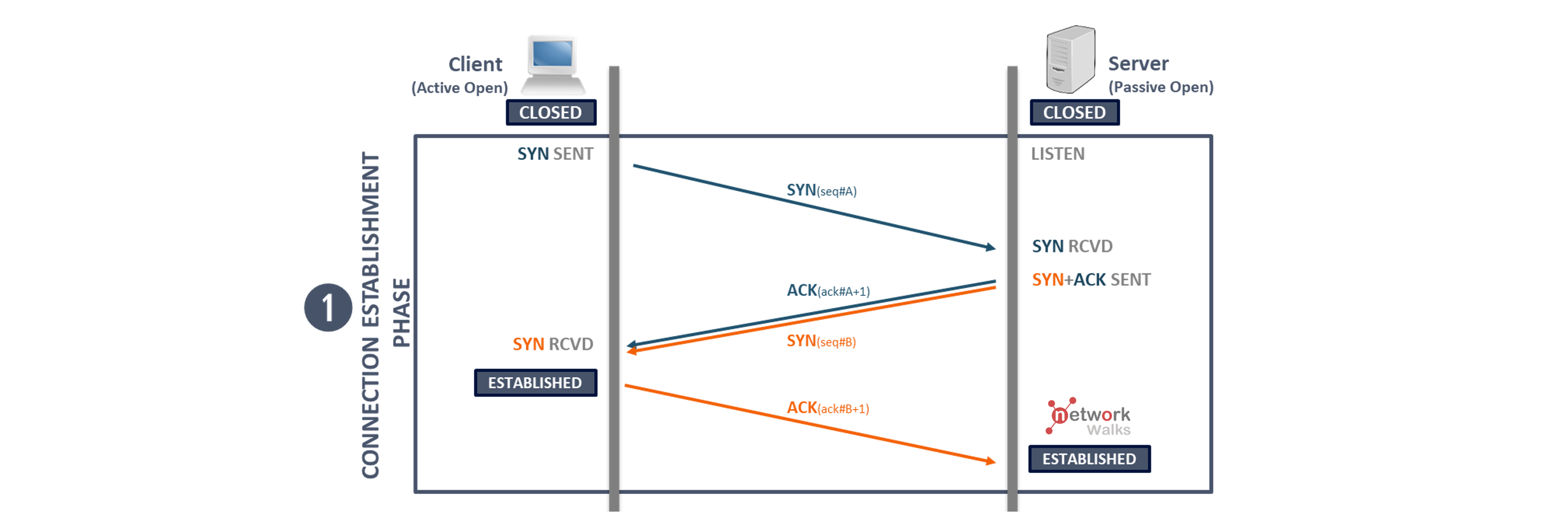
Before TCP sends a single byte of data, it wants to make sure the other computer is actually ready to talk. It doesn't just "shout" into the void; it performs a formal introduction called the 3-Way Handshake.
Think of it like a polite phone conversation:
SYN (Synchronize): You call your friend and ask, "Hey, I want to tell you something. Are you free to talk?"
SYN-ACK (Synchronize-Acknowledge): Your friend picks up and says, "Hey! Yes, I'm free, and I'm ready to listen. Can you hear me okay?"
ACK (Acknowledge): You respond, "Great, I hear you loud and clear. Here is the info..."
Step-by-Step Breakdown:
Step 1 (SYN): The client sends a "Synchronize" packet to the server. This packet contains a random "Sequence Number" to start the tracking.
Step 2 (SYN-ACK): The server receives it and sends back a "Synchronize-Acknowledge" packet. It says "I received your number" and provides its own starting number.
Step 3 (ACK): The client sends a final "Acknowledge" packet. The connection is now established!
How Data Transfer Works: Order and Correctness
Once the handshake is done, the data starts flowing. TCP uses two clever tricks to keep things organized: Sequence Numbers and Acknowledgements.
Sequence Numbers: Every packet gets a "page number." If you send 10 packets, TCP labels them 1 through 10. Even if packet #5 arrives before packet #2, the receiving computer knows exactly where it fits in the sequence.
Acknowledgements (The "Got it!" system): Every time the receiver gets a packet, it sends back a tiny message saying, "I got packet #3!" If the sender doesn't hear that "Got it!" message within a certain timeframe, it assumes the packet was lost and sends it again.
This is how TCP ensures reliability. It’s obsessed with making sure nothing is left behind.
Dealing with Problems: Loss and Retransmission
The internet is a messy place. Sometimes a router crashes, or a Wi-Fi signal drops. If a packet disappears into the digital abyss, TCP doesn't panic.
Because it tracks every packet, it knows exactly which one is missing. It will simply retransmit that specific missing piece. It also has a built-in "checksum" (a mathematical fingerprint) to make sure a packet wasn't corrupted or changed during its journey.
The Goodbye: Closing the Connection
When the data transfer is finished, TCP doesn't just hang up. It performs a "graceful shutdown" to ensure no data is cut off mid-sentence. This usually involves a four-step process using FIN (Finish) and ACK (Acknowledge) flags.
Client: "I'm done sending data. (FIN)"
Server: "I hear you. Let me just finish processing what I have. (ACK)"
Server: "Okay, I'm done too. (FIN)"
Client: "Got it. Goodbye! (ACK)"
Summary: The Foundation of the Web
TCP is the reason you can download a massive software update or load a complex webpage without everything falling apart. It favors accuracy over speed, making it the perfect partner for protocols like HTTP (the web) and SMTP (email).
Without this digital handshake and its obsessive record-keeping, the internet would be a much more broken and confusing place.


